

Kordsa introduces new fast press curable resin


EPR exclusion being overlooked in national implementations, such as in Spain and the Netherlands, associations say.
15th December 2025
Innovation in Textiles
|
Brussels
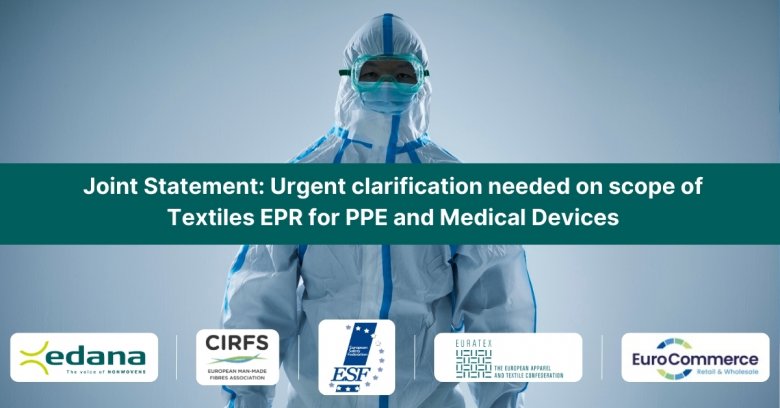
European textiles and nonwovens industry associations CIRFS, EDANA, ESF, Euratex and EuroCommerce have issued a joint statement raising critical concerns regarding the transposition of EU Directive 2025/1892, the targeted revision of the Waste Framework Directive.
As Member States begin implementing Extended Producer Responsibility (EPR) for textiles, a lack of distinction within the directive’s annex is causing confusion. Currently, the specified CN codes do not distinguish between standard apparel and essential personal protective equipment (PPE) or medical devices.
The joint statement highlights that PPE and medical devices are engineered to protect users from hazardous environments, including chemical, biological, and radiological risks. Consequently, these garments often become contaminated and are classified as hazardous waste requiring incineration rather than recycling, to ensure safety.
Including these products in standard textile EPR schemes poses significant risks including cross contamination – mixing hazardous PPE waste with household textiles threatens human health and environmental safety.
Contaminated PPE disposal is already regulated under Articles 13, 17, 18, and 19 of the existing Waste Framework Directive and PPE also constitutes less than 1% of textile waste, with 80-90% treated as hazardous. The environmental benefit of recycling the remaining fraction is negligible compared to the transport required to aggregate sufficient volumes.
The statement also calls for guidance on safety shoes. Like other PPE, these items face contamination issues that limit recyclability. Furthermore, manufacturers cannot guarantee product warranties or conformity for reused safety footwear and the fee scaling for heavy items such as steel-toed boots remains unclear.
Recital 28 of the directive already suggests that products posing safety or hygiene risks should be excluded from the EPR. However, this is being overlooked in national implementations, such as in Spain and the Netherlands.
As a consequence, the signatories urge the European Commission to issue clear guidance to Member States confirming that products complying with the PPE Regulation (2016/425) and the MD Regulation (2017/745) are outside the scope of EPR on textiles.

Business intelligence for the fibre, textiles and apparel industries: technologies, innovations, markets, investments, trade policy, sourcing, strategy...
Find out more