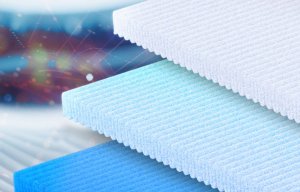

TFP nonwovens on display at JEC World


Geotextiles one of the most influential yet least recognised technologies shaping the contruction of modern landmarks.
23rd December 2025
Innovation in Textiles
|
Palm Jebel Ali , Dubai, UAE
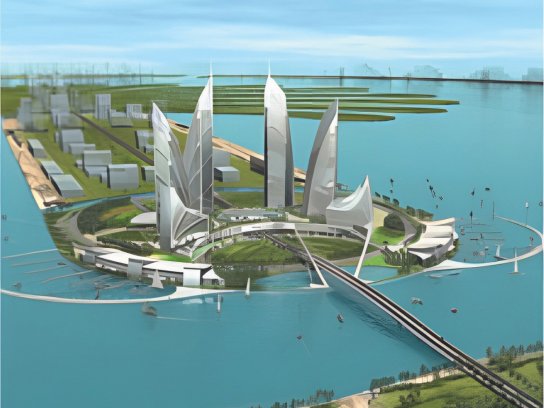
Palm Jebel Ali – a second ambitious artificial archipelago off Dubai’s Jebel Ali coast – is making a high-profile return after years of stalled progress.
This is good news for the construction industry and for the manufacturers of geotextiles and other engineered nonwoven fabrics who will be involved, according to Palexpo, organiser of the INDEX exhibition which takes place again in Geneva, Switzerland from May 19-22 2026.
Initially launched in 2002, the project was to be a palm-shaped island even larger than its famed sibling, Palm Jumeirah (billed as ‘The 8th Wonder of the World’), but suffered delays and suspension following the global financial crisis of 2008.
After remaining largely on hold for over a decade, Palm Jebel Ali was formally relaunched in 2023, with construction resuming in 2024 under a revised master plan targeting completion around 2028.
The renewed vision is bolder and more sustainable. At about 13.4 square metres, the island is now designed to be more than twice the size of Palm Jumeirah, adding nearly 100 kilometres of new coastline to Dubai’s map. It includes multiple fronds, interconnected islands, luxury residential units, hotel and resort zones, marinas and extensive waterfront amenities.
A key aim is to blend high-end living with smarter infrastructure, environmental consciousness and modern urban planning, marking a step beyond the purely spectacle-driven island developments of the past.
Palm Jumeirah
Completed around 2006/07, Palm Jumeirah required massive engineering works to transform marine seabed into a stable platform for residential, hotel and infrastructure development. Underlying that ambition was a need to manage soil, water and structural stability in a highly demanding environment of waves, tides and fine and sometimes mobile sediments.
One company heavily involved in this work was INDEX™26 exhibitor Fibertex, as the supplier of engineered fabrics for several of Palm Jumeirah’s containment, separation, drainage and stabilisation functions.
For the breakwater protecting Palm Jumeirah’s outer edge, a specific nonwoven grade was used as a stabilising geotextile. In effect, this fabric was laid between structural rock layers or between rock and sand zones to prevent migration of fine particles, filter subsurface flows, and preserve the intended layering.
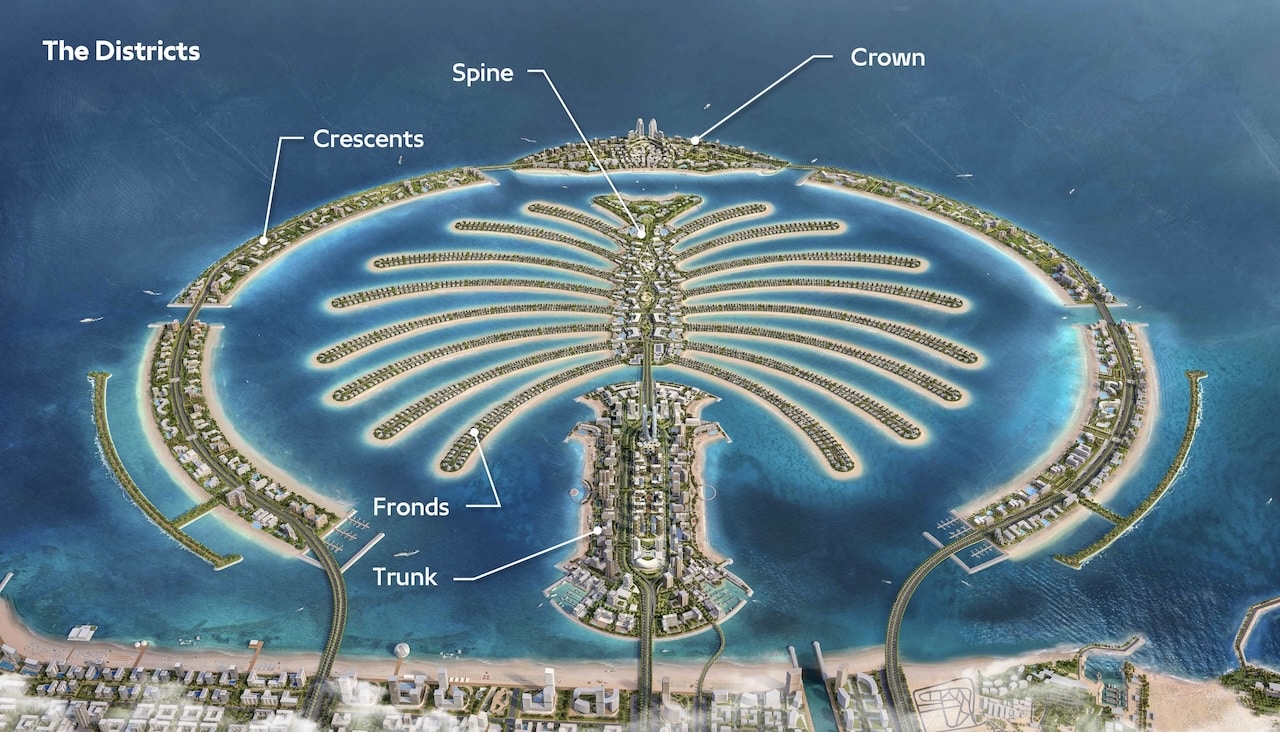
In a marine rock-fill breakwater, designers traditionally achieve filtration with graded stone filters alone. That approach is robust but demands precise gradation and thicker sections. A high-strength, puncture-resistant nonwoven delivers the same filter/separator function in a thinner interface, while accommodating differential settlement and allowing free water flow to relieve pore pressures.
The breakwater itself is substantial – the Palm’s protective seawall runs is around 12 kilometres in length and roughly 200 metres wide, forming a barrier that must resist wave and storm action while preventing seabed scour and internal erosion.
The geotextile layer thus acts as a demarcation/interface between rock armour and the inner sand and gravel fill materials in order to maintain the mechanical integrity of the breakwater and reduce mixing of layers under hydraulic stress.
The involvement of Fibertex in the project, however, went further. various grades of the company’s nonwoven geotextiles were specified for the reclaimed island’s internal infrastructure, including the roads on each frond as well as drainage systems and landscaping.
Landmarks
Nonwoven geotextiles have become one of the most influential yet least recognised technologies shaping the contruction of modern landmarks. Through careful control of fibre type, density and bonding method, engineers have created materials that can filter, separate, drain and reinforce in ways once unimaginable. They are now used wherever earth meets infrastructure – between layers of aggregate, behind retaining walls, beneath pavements, along riverbanks and below rail beds. Their dual nature is significant – they are strong enough to withstand immense stresses, yet porous enough to allow water to flow freely.
The idea of using textiles in soil is not new and even the Romans stabilised roads with layers of organic fibre, but nonwoven geotextiles have made it possible to apply the same principle on a scale suited to 21st Century construction. These materials first came to prominence in the 1970s and 1980s when engineers sought reliable separation layers for highways and embankments. Since then, they have quietly found their way into some of the world’s most recognisable civil works.
Runways and tunnels
In the runways of airports, for example, carefully layered structures of base course and treated subgrade lie below the concrete surface. Between these, a nonwoven layer acts as a bond breaker and separator, preventing the upward movement of fine particles and relieving stresses that could cause cracking at the surface.
This small intervention can extend the runway’s’s life by decades and reduce the frequency of costly closures. At such sites, the stakes are high – aircraft weighing hundreds of tons depend on uniform support and impeccable drainage and the nonwoven layer ensures both.
In tunnels and underground rail networks, nonwovens perform a different yet equally critical function. Behind the waterproofing membranes that line the excavation, they serve as protective cushions, allowing the flexible membranes to accommodate ground movement without puncture. They channel seepage water into drainage systems, keeping the tunnel interior dry and safe. The great subterranean arteries of modern cities – their metros, deep stations and cut-and-cover highways – are lined with these unseen fabrics. When commuters move effortlessly through stations that might once have dripped with moisture, they are benefitting from the quiet performance of a nonwoven layer only a few millimetres thick.
Erosion control
In dam and reservoir construction, nonwoven geotextiles meanwhile provide filtration and erosion control in zones where fine soils meet coarse drainage aggregates. Their role here is to hold back the soil while allowing water to pass, preventing the formation of internal erosion channels that can threaten stability. Some of the most ambitious water projects in the world have relied on them to safeguard the transition between impervious cores and drainage layers. Decades after installation, many continue to perform flawlessly – illustrating their durability under constant load and hydraulic pressure.
Coastal and river protection projects, too, have embraced nonwovens. Beneath rock armour, breakwaters or sand-filled tubes, they stabilise the subsoil and prevent scour by wave action. When severe storms strike, these layers can be the difference between an intact shoreline and a collapsed embankment. In ports and estuaries where space is limited, nonwovens have enabled the construction of vertical quay walls and reclaimed land by controlling the migration of fines and maintaining hydraulic balance. They are the quiet custodians of modern coastlines, extending the life of structures that face the full force of nature.
Quiet strength
When Palm Jebel Ali rises from the Gulf, it will stand as a further reminder that the most visionary feats of engineering depend not only on grand designs but also on the quiet strength of the materials beneath them.
Nonwoven geotextiles, though unseen, remain key tools of such progress and in playing their part in shaping the 9th Wonder of the World, will once again reaffirm their place at the foundation of modern civilisation’s most ambitious landscapes.

Business intelligence for the fibre, textiles and apparel industries: technologies, innovations, markets, investments, trade policy, sourcing, strategy...
Find out more