
ReHubs to outline Europe-wide strategy in Dornbirn


Europe’s established textile ecosystem has proved more fragmented and constrained than anticipated.
1st December 2025
Innovation in Textiles
|
Brussels, Belgium
Brussels-headquartered ReHubs has pushed back its initial target of regenerating 2.5 million tons of European post-consumer textile waste by 2030, to 2032.
The organisation was formed in 2022 as a response to the rapidly growing mountain of post-consumer textile waste in Europe and the stubborn inability of the sector to transform it into high-value new materials at scale.
It brings together key players across the supply chain, from fibres and raw materials suppliers such as BASF, Indorama and Lenzing, to major brands including Decathlon, Inditex and Mango. Importantly, members also include key established textile recycling companies such as TexAid – although this company’s German arm filed for insolvency in July this year, as an indication of the difficulties the recycling market currently faces.
Synergy driven
Nevertheless, conceived as a synergy-driven alliance, the aim of ReHubs is to break the systemic supply-demand deadlock in textile recycling – a stalemate in which recyclers cannot justify investment without guaranteed demand, while brands remain hesitant to commit without reliable and competitively priced recycled fibres.
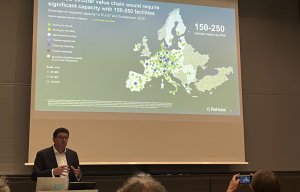
“We announced ReHubs in 2022 and have made progress, but not the progress we were hoping for,” admitted CEO Robert van de Kerkhof during a recent webinar organised by Go Circular. “At this early stage, recycled fibres are much more expensive, but once we are at scale we believe they will become much more competitive, so the question is, how can we get from where we are today to where we want to be? This is where EPR schemes are going to be really critical in order to finance the investments that are needed.”
To go from a linear textile value chain to a circular textile-recycling value chain, he explained, five main parts of the value chain must be matured and scaled – collection, sorting for reuse, sorting for recycling, pre-processing and recycling itself.
Integration
“These steps already exist but they are not integrated in the ongoing supply chain so we have collectors and sorters doing a very good job but mainly at present sorting for resale and they don’t have the product specifications yet for the recyclers,” van de Kerkhof explained. “The recyclers are both start-ups and also very established players that are looking for the right quality and the right quantity of feedstock. While each individual step exists, all players need to adapt and learn from each other to make a circular value chain a reality.”
Europe’s established textile ecosystem has proved more fragmented and constrained than anticipated, he added. Inadequate collection and sorting capacities, inconsistent feedstock quality, underdeveloped recycling infrastructure and a complex regulatory landscape have slowed the pace of transformation. Recyclers have experienced pilot fatigue as they have tested new technologies without securing bulk offtake contracts and brands have faced rising costs and margin pressure, making the large-scale adoption of recycled fibres more difficult than anticipated.
Rather than dilute its ambition, however, ReHubs has chosen to recalibrate and there are many positive signs. There has been, for example, much progress in both chemical recycling and in automated sourcing, while mechanical recycling capacities have more than doubled in Europe since 2020. In addition, EPR (extended producer responsibility) systems have been introduced in key markets and brands have set targets for recycled materials as percentages of their overall portfolios.
Strategic pillars
Central to the ReHubs approach are two strategic pillars – end-to-end supply chain management and the orchestration of finance, supported by a robust foundation of network leadership and standards harmonisation. By coordinating logistics, sorting, processing and manufacturing, ReHubs is seeking to create predictable pricing, consistent quality and reliable volumes of recycled fibres at conditions essential for scaling demand.
At the same time, it is working on blended financing models that pool public funds, private capital and brand commitments, in order to derisk early investments and catalyse capacity expansion across Europe.
This integrated model directly addresses the financial and operational constraints that have so far limited textile-to-textile recycling.
Studies commissioned by ReHubs estimate that €5-6 billion is needed to initiate this circular transition in Europe, laying the groundwork for a far larger investment requirement in the longer term.
“By aligning capital with coordinated demand signals and infrastructure planning, ReHubs is paving the way for industrial-scale solutions that are both economically viable and environmentally sound,” van de Kerkhof concluded.

Business intelligence for the fibre, textiles and apparel industries: technologies, innovations, markets, investments, trade policy, sourcing, strategy...
Find out more